Cats
Voices from ChernobylCats in Voices from Chernobyl are not simply remnants of deserted homes: they wait for absent people, adapt to hunger, evade capture, and become companions whose lives matter to the people who stay behind or arrive to clear the contaminated settlements. Their stories move between intimate acts of care and mass abandonment, making visible the animals who have no place in official accounts of evacuation and cleanup.
Left Behind and Cared For
When the villagers left, they left Cats behind. One woman remembers spending the first days carrying milk to them and giving Dogs pieces of bread. The Cats waited in their yards for their masters; as hunger deepened, they ate cucumbers and tomatoes. She continued tending a neighbor’s lawn and repaired its fallen fence, waiting for the people to return. Her appeal to the neighbor’s dog, Zhuchok, to call out if the people came first turns the empty village into a place where an animal might still serve as a messenger between human beings.
That care was not easy or sentimental. In winter, rats attacked one woman’s house and got into a barrel of grain. Her cat Vaska, she says, saved her; they shared meals and seemed to talk. Then he disappeared. She feared hungry Dogs had eaten him, recalling how animals without food could die and how Cats might even eat their kittens in winter. The story gives hunger its own harsh ecology: abandonment is not a single moment, but a condition that changes what animals can find and what they do to survive.
The woman later describes searching the village for a lost cat, calling out names as she went into other people’s yards. After two days of looking, she found a cat under the store. He did not follow at once; he meowed while she tried to persuade him to come home, offering eggs and lard. She walked ahead and he ran after her. She named him Vaska too, and says they had lived together for two winters. The account does not erase the first Vaska’s disappearance; instead, it holds loss and a renewed bond side by side. The second cat becomes a companion with whom the woman can speak and share the small routines of life.
Survival in the Empty Houses
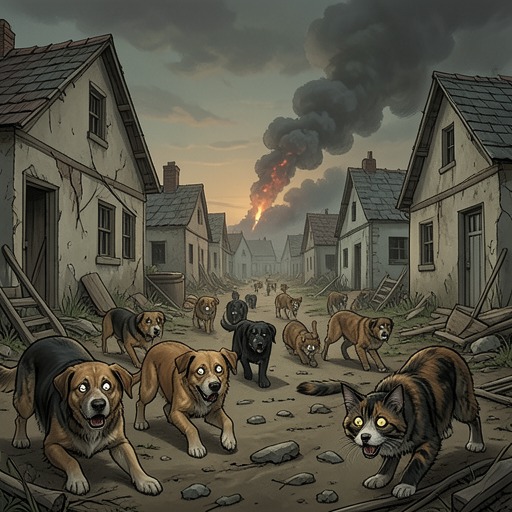
The cleanup workers encounter Cats in a different condition: not as pets waiting in familiar yards, but as frightened animals sheltering in houses emptied of their people. One worker recalls sealed homes where Cats could be seen through the windows. After robbers broke in and stripped the rooms, surviving Dogs moved inside and no longer trusted people. Cats hid beneath stoves or inside a clay pot; workers pulled them out and chased them with rifles. The animals were thin and dirty, their fur clumped together. Their lives had become entangled with the breakdown of the human settlement: when eggs ran out, Dogs and Cats ate the chickens, and Dogs began eating Cats.
Other accounts make the abandoned houses memorable precisely because animals remain where people are expected. A worker sees a cat on a windowsill and first thinks it is a clay figure; it is real, and has eaten the geraniums inside. Another remembers a note asking visitors not to beat a cat because the rats would otherwise eat everything, and a child’s plea, “Don’t kill our Zhulka. She’s a good cat.” Such messages make the empty house speak in the absent residents’ voices, while the cat’s presence shows that departure did not end the household’s dependence on animals—or the animals’ dependence on people.
The same reversal recurs in the soldiers’ camps. The villages have been emptied, and Cats gather around piles of empty food cans. A gate opens; a worker turns expecting a person, but a cat walks out. The familiar signs of a human arrival have become signs of animal survival. Cats remain inside the structures people built, but the ordinary expectations attached to those structures no longer hold.
Evacuation and Human Decisions
The accounts distinguish care for a particular animal from the rules imposed on whole populations. One old woman living in a village had five Cats and three Dogs and refused to give them up. The hunters took most of the animals by force, leaving her one Cat and one Dog. She cursed them and called them bandits and jailers. In another evacuation, an old woman emerged carrying an icon, a Cat, and a small bundle. When told that the cat’s fur was radioactive and that she could not bring him, she refused to leave without him, saying, “He’s my family.” The sparse bundle makes the bond unmistakable: in the moment of forced departure, the Cat is not an extra possession but one of the few lives she insists on taking with her.
The possibility of saving animals on a larger scale appears in a cameraman’s account of a proposed evacuation project. He had heard that someone suggested moving animals along with people in the first months after the accident. The proposal immediately opens into questions of scale: how to relocate animals living underground or flying in the sky, and how to give them the information needed to move. The problem is not resolved by the accounts. Instead, it exposes how an evacuation organized around people leaves other forms of life outside the plan, even when their presence is impossible to ignore.
Killing, Memory, and Animal Lives
For the cleanup workers and hunters, Cats could be both victims and targets. One hunter describes villages surrounded during operations in which Dogs ran into the forest at the first shot while Cats hid more effectively. Workers searched under stoves and inside hiding places, and some Cats dashed past their boots as they pursued them with rifles. The speaker compares the operation to war and punishment, but the details resist turning it into an abstract military task: there were frightened animals, exhausted by hunger, and people who had to decide what to do with them. The story of the old woman whose animals were taken by force shows how the same action could be experienced as necessary procedure by one side and an assault on family by the other.
The killing leaves a record that is both large and impersonal. One speaker imagines future discoveries of animal burial grounds, or “bio-cemeteries,” where thousands of shot Cats, Dogs, and Horses lie without a single name. Elsewhere, a speaker describes the appearance of wolf-dog offspring and claims that feral Cats have formed packs and attack humans, interpreting this as revenge and as evidence that the boundary between the real and unreal is disappearing. The statement is presented as part of the speaker’s unsettling account, not as a neutral explanation of animal behavior. In these passages, Cats are at once creatures acted upon by human decisions and beings imagined as escaping human control.
A filmmaker’s encounters with abandoned animals change what he wants to record. After an old woman refuses to leave her Cat, he says he began filming animals; later, a child watching his films asks, “Why couldn’t anyone help the animals?” The question stays with him because art and public concern, as he sees them, focus on human suffering and love rather than on other living things. He wants to make a film called “Hostages” and to see the world through an animal’s eyes. Across the testimonies, Cats make that shift of attention concrete: some are individually remembered, fed, searched for, and carried away; others hide, starve, or are shot without names. Their varied fates reveal the limits of a human-centered account of catastrophe and preserve, in the smallest household encounters, the claim that animal lives belong within its story.